

早已超越了一部电影的范畴,《肖申克的救赎》已成为现代人的精神寓言。它深刻探讨了体制与个人、绝望与希望、虚伪与虔诚、沉沦与救赎的永恒母题。
那么,这部电影究竟讲述了什么?如果说肖申克是一座监狱,芝华塔尼欧又代表什么?那把小鹤嘴锄为何藏在圣经的《出埃及记》章节?影片中三次出现的水的意象——污浊的下水道水、滂沱的雨水、湛蓝的太平洋海水——又意味着什么?
现在,就让我们将这些隐藏的隐喻串联在一起,重新走过安迪·杜弗兰的狱中十九年,并审视瑞德如何用四十年完成内心的“出埃及记”。
一、高墙与人:肖申克的三张面孔
影片开场,银行家安迪从人生巅峰跌入谷底。二十多岁的他,因被指控谋杀妻子而入狱。1947年春天,安迪被扔进了肖申克监狱。航拍镜头下,人在高墙内渺小如蝼蚁。
瑞德出场了,他以特有的烟嗓承担了电影的旁白。我们看到的第一个场景便是“赌局”:老囚犯们以新犯人取乐,打赌谁第一个崩溃。海伍德赌那个大个子,而瑞德看安迪文弱,赌他会输。结果当晚,大个子就被狱警殴打至崩溃,而安迪一声未吭。瑞德输了两包烟,这也是他第一次对安迪判断失误。
电影开头便向我们展示了狱中的三张面孔:
-
海伍德的面孔:代表了底层社会的冷漠。当那个大个子死后,安迪问他的名字,海伍德却反应道:“关你屁事?人都死了,名字还有什么意义?” 在这类环境中,个体的崩溃甚至不配被记住。
-
瑞德的面孔:一个已被体制化二十年的“老油条”。他活得明白而悲观,认为“希望是危险的东西”,并早已接受了现状。
-
老布鲁克斯的面孔:一个完全与监狱融为一体的老人。他养了一只乌鸦,甚至为监狱而生,一旦离开便无法生存。
看完电影,我们或许可以反思:自己是否也是其中的某一种?
二、鹤嘴锄与啤酒:希望的初次萌动
瑞德是监狱里的“百货商店”,能搞到各种东西。安迪找他订购了一把小鹤嘴锄。瑞德开玩笑:“你不是想越狱吧?”拿到工具后他自己也笑了:“用这个挖地道,得花六百年。” 此时是1947年,安迪入狱第一年。夜里,安迪打量着有点松软的石墙,刻下了自己的名字——这个细节被巧妙地隐藏在叙事中。
两年后,一次户外劳动中,安迪冒着被扔下楼的危险,为狱警哈德利提供了避税建议,换取的是让同伴们每人喝上三瓶冰啤酒。那一刻,阳光洒肩头,仿佛重获自由。安迪自己却戒了酒,只是微笑坐着。
这个事件成为拐点,安迪自此受到犯人尊重,并成为狱警的“理财顾问”,最终引起了典狱长诺顿的注意,开始为他处理黑账。
三、希望是危险的东西?两种世界观的交锋
影片用大量篇幅展现安迪如何以愚公移山般的精神对抗荒芜:他坚持写信六年,建起了最好的监狱图书馆;他播放《费加罗的婚礼》,让音乐响彻监狱。安迪说,有些地方是石墙关不住的,那就是希望。
瑞德却泼来冷水:“希望是危险的东西。” 这不是抬杠,而是两种世界观的碰撞。瑞德代表“层内自洽”:接受现实,别抱幻想;安迪则代表“层级跨越”:从不承认自己属于肖申克。安迪反问:“就像布鲁克斯那样吗?” 瑞德无言以对。
四、自杀的布鲁克斯:体制化的终极悲剧
老布,1902年入狱,在肖申克度过了大半生。假释出狱后,外部世界对他来说比监狱更可怕。他在房梁刻下“老布到此一游”,然后上吊自杀。他能在监狱活几十年,却在自由世界活不过一年。在某种意义上,我们是否也是那个“布鲁克斯”?
导演用一个极具深意的镜头为老布的悲剧定格:当他走出监狱大门时,镜头是从外部向里拍摄的。老布只是物理上走出了大门,他的心和灵魂,永远被锁在了门内的阴影里。他从未获得真正的自由。
五、光的审判:瑞德的三次假释与内心觉醒
瑞德的救赎之路,与安迪的越狱平行,却以另一种形式展开。导演用精妙的镜头语言,通过三次假释审查,勾勒出他内心觉醒的全过程。
第一次假释(入狱20年):表演与拒绝
房间里虽有窗户,却没有阳光。瑞德用流畅的表演,给出他认为委员会想听的“标准答案”:“是的,先生,我绝对改过自新了。”摩根·弗里曼飘忽的眼神,让这一切充满了空洞的保证。他试图迎合权威,换来的是一句“驳回”。
第二次假释(入狱30年):怀疑与疲惫
十年后,阳光透过窗户照进房间,落在了瑞德身上,但并未照亮他的脸。他的回答虽更坚定,眼中却充满了对三十年虚度的悔恨与疲惫。他已不再渴望假释,因为他看透了这个系统“无关改过自新,只关乎惩罚”。
第三次假释(入狱40年):觉醒与自由
此时安迪已成功越狱。明媚的阳光彻底洒在瑞德的脸上。当被问及是否“改过自新”时,他给出了石破天惊的回答:
“改过自新?我根本不知道那是什么意思…对我来说那只是个编出来的词。”
他第一次不再表演,而是说出真话。他的后悔,不再是为了取悦他人,而是基于对生命的深刻反思:“我无时无刻不感到后悔,但并非因为我被困在这里…我后悔,是因为那个犯下重罪的愚蠢少年。”
那句“我他妈根本不在乎”,标志着他已在精神上获得了与安迪同等的自由。当他最终获释走出大门时,镜头跟随在他身后,一同从监狱内部走向广阔的外部世界。从此,监狱再也没有出现在镜头中——他不仅身体走出了牢笼,灵魂也彻底告别了那里。
六、在暴雨中呼喊:安迪的“出埃及记”
瑞德在精神上挣脱枷锁的同时,安迪完成了肉体的传奇越狱。1965年,新犯人汤米透露了真凶的秘密,让安迪重燃希望。而这希望被典狱长诺顿亲手掐灭——汤米被陷害致死。诺顿用行动证明了瑞德的话:希望是痛苦的根源。
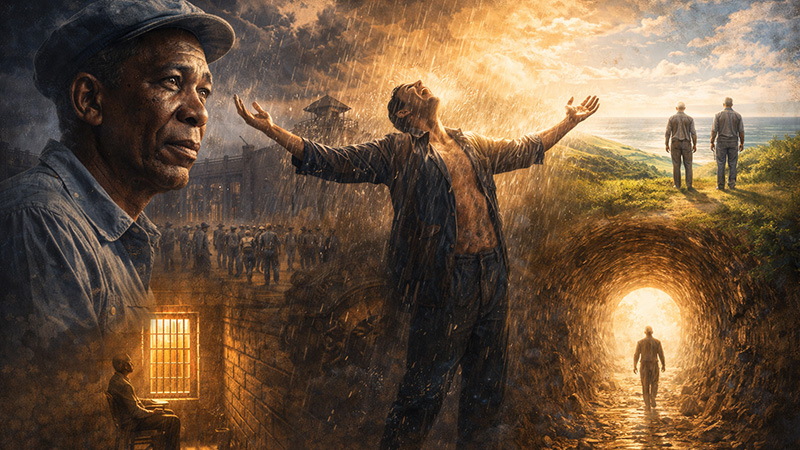
安迪变得沉默,还买了一根绳子。瑞德担心他会像老布一样寻短见。然而第二天,安迪消失了。他穿越了自己挖掘的隧道,爬过近五百米恶臭的下水道,在雷雨交加的夜晚重获自由。他撕去囚衣,仰天张开双臂,任由雨水冲刷十九年的屈辱。
七、影片的核心象征体系
-
鸟的意象:老布养的乌鸦羽毛漆黑,象征其被体制吞噬的生命;瑞德形容安迪的音乐像“美丽的小鸟”,后来又说“有些鸟是关不住的”,喻指安迪光辉不屈的灵魂。
-
圣经与鹤嘴锄:典狱长伪善地说“救赎之道,就在其中”,而安迪将鹤嘴锄藏在《出埃及记》章节,正隐喻着一场现代的“出埃及记”——逃离精神的埃及(奴役之地)。
-
海报与时光:墙上的女星海报从丽塔·海华丝到玛丽莲·梦露,再到拉奎尔·韦尔奇,既是时代的变迁,也是完美掩护越狱计划的墙纸。
-
三次水的意象:下水道的污水象征肮脏的狱中岁月;滂沱的雨水是冲刷与洗礼;太平洋的蓝色海水则代表没有记忆的自由与新生。
八、从肖申克到芝华塔尼欧:游到海水变蓝
安迪的复仇优雅而致命。他取走黑钱,揭发罪证,诺顿在绝望中自杀。瑞德最终假释出狱,在手枪与指南针之间,他选择了后者,遵循安迪的指引,奔赴太平洋畔的芝华塔尼欧。
那里有“没有记忆的海洋”。从污水、雨水到海水,完成了从污浊到纯净、从禁锢到自由的升华。它象征着漫长冬季后的“别回头,向前看”,亦如“一直游,游到海水变蓝”。
两位老友在蔚蓝的海岸重逢。整部电影告诉我们,肖申克从未有救世主,救赎之道不在圣经里,而在每个人心中。影片通过安迪(行动的越狱者)、瑞德(心灵的觉醒者)与老布(体制的牺牲品)三条路径,终极叩问:真正的自由,是逃离高墙,还是照亮内心?安迪用十九年凿穿了墙壁,瑞德用四十年放下了心墙,他们共同给出了答案。
An In-Depth Analysis of The Shawshank Redemption: Metaphors, Redemption, and the Path to True Freedom

Transcending the realm of mere cinema, The Shawshank Redemption has become a modern spiritual parable. It profoundly explores the eternal themes of institution versus the individual, despair versus hope, hypocrisy versus sincerity, and downfall versus salvation.
So, what does this film truly tell? If Shawshank is a prison, what does Zihuatanejo represent? Why is that small rock hammer hidden in the Book of Exodus in the Bible? And what is the meaning behind the three water motifs in the film—the filthy sewage water, the torrential rainwater, and the blue seawater of the Pacific?
Now, let us connect these hidden metaphors and retrace Andy Dufresne’s nineteen years in prison, while also examining how Red completes his inner “exodus” over forty years.
I. The Walls and the Men: Three Faces of Shawshank
The film opens with banker Andy Dufresne falling from the peak of life into the abyss. In his twenties, he is imprisoned for the alleged murder of his wife. In the spring of 1947, Andy is thrown into Shawshank. In the aerial shot, humans appear as insignificant as ants within the high walls.
Red appears, providing the film’s first-person narration in his distinctive smoky voice. The first scene we witness is a “betting game”: veteran prisoners amuse themselves by wagering on which new inmate will break first. Heywood bets on the big guy, while Red, seeing Andy as bookish and weak, bets against him. That very night, the big guy breaks, beaten nearly to death by guard Hadley, while Andy remains silent. Red loses two packs of cigarettes—his first misjudgment of Andy.
The beginning of the film presents us with three faces of Shawshank:
The Face of Heywood: Representing the indifference of the underclass. When the big guy dies and Andy asks for his name, Heywood retorts, “The fuck do you care, new fish? He’s dead. Didn’t fucking matter what his name was.” In such an environment, an individual’s breakdown isn’t even worthy of being remembered.
The Face of Red: A “veteran” institutionalized for twenty years. He lives understandably yet pessimistically, believing “hope is a dangerous thing,” and has long accepted his reality.
The Face of Old Brooks: An old man completely integrated into the prison. He keeps a pet crow and seems almost born for Shawshank. Once outside, he cannot survive.
After watching the film, we might reflect: are we, in some sense, one of them?
II. The Rock Hammer and Beer: The First Sprout of Hope
Red is the prison’s “go-to guy,” able to procure anything. Andy approaches him to order a small rock hammer. Red jokes, “You’re not thinking of escaping, are ya?” When he later sees the tool, he laughs: “You’d have to crawl through a river of shit to get to this, and it’d take you six hundred years.” It is 1947, Andy’s first year. At night, Andy examines the soft stone wall, carving his name—a detail cleverly hidden within the narrative.
Two years later, during outdoor labor, Andy risks being thrown off a roof by offering guard Hadley tax advice in exchange for three ice-cold beers for each of his fellow workers. For a moment, with the sun on their shoulders, they feel free again. Andy himself has quit drinking and merely sits smiling.
This event becomes a turning point. Andy gains respect from the inmates and becomes the guards’ “financial advisor,” eventually catching the attention of Warden Norton, for whom he begins laundering money.
III. Is Hope a Dangerous Thing? A Clash of Two Worldviews
The film spends considerable time showing how Andy fights spiritual desolation with an almost obsessive, dogged perseverance. He writes letters for six years, building the best prison library in New England. He plays The Marriage of Figaro, letting music flood the prison. Andy says some places aren’t made of stone, that place is called hope.
Red douses this with cold water: “Hope is a dangerous thing.” This is not argument but a clash of worldviews. Red represents “intra-stratum coherence”: accept reality, harbor no illusions. Andy represents “stratum transcendence”: he never admits he belongs to Shawshank. Andy retorts, “Like Brooks did?” Red has no answer.
IV. Brooks’s Suicide: The Ultimate Tragedy of Institutionalization
Brooks, imprisoned in 1902, spent most of his life in Shawshank. Paroled, the outside world is more terrifying to him than prison. He carves “Brooks was here” on a beam and hangs himself. He could survive decades inside but not one year in freedom. In a sense, are we also that “Brooks”?
The director frames Brooks’s tragedy with a deeply meaningful shot: as he walks out the prison gates, the camera is positioned outside, looking in. Brooks has only physically exited; his heart and soul remain locked in the shadows behind those gates. He never attained true freedom.
V. The Trial by Light: Red’s Three Parole Hearings and Inner Awakening
Red’s path to redemption runs parallel to Andy’s escape, unfolding in a different form. Through three parole hearings, the director uses exquisite cinematic language to outline his inner awakening.
First Parole Hearing (20 years): Performance and Rejection
The room has windows, but no sunlight enters. Red performs fluently, giving what he thinks is the “standard answer” the board wants: “Oh, yes, sir. Absolutely, sir. I’ve been rehabilitated.” Morgan Freeman’s shifty eyes render this assurance hollow. He tries to please authority and receives a “Rejected.”Second Parole Hearing (30 years): Doubt and Weariness
Ten years later, sunlight streams through the window, falling on Red’s body but not illuminating his face. His answer is firmer, but his eyes are filled with regret and weariness for thirty wasted years. He no longer desires parole, seeing through the system as being “not about rehabilitation, only about punishment.”Third Parole Hearing (40 years): Awakening and Freedom
By now, Andy has escaped. Bright sunlight fully bathes Red’s face. Asked if he’s been “rehabilitated,” he gives a groundbreaking answer:“Rehabilitated? Well, now, let me see… I don’t have any idea what that means… To me, it’s just a made-up word.”
For the first time, he doesn’t perform but speaks his truth. His regret is no longer to please others but stems from deep reflection on life: “There’s not a day goes by I don’t feel regret… Not because I’m in here… I look back on the way I was then… a young, stupid kid who committed that terrible crime.”
The line “I don’t give a shit” signifies he has already attained the same spiritual freedom Andy possessed. When he is finally released and walks out the gates, the camera follows behind him, moving from the prison’s interior to the vast outside world. From that point on, the prison never appears in the frame again—he has not only physically left his cage but has spiritually departed forever.VI. Crying Out in the Storm: Andy’s “Exodus”
As Red breaks his spiritual chains, Andy accomplishes his legendary physical escape. In 1965, new inmate Tommy reveals the secret of the real murderer, reigniting Andy’s hope. This hope is crushed by Warden Norton—Tommy is framed and killed. Norton proves Red’s words: hope can be the source of pain.
Andy falls silent and even buys a rope. Red fears he will end like Brooks. But the next day, Andy is gone. He crawls through the tunnel he dug, through nearly five hundred meters of foul sewage, and emerges into a thunderstorm. He tears off his prison clothes, stretches his arms to the sky, and lets the rain wash away nineteen years of humiliation.
VII. The Core Symbolic System of the Film
The Bird Motif: Brooks’s crow has black feathers, symbolizing a life consumed by the institution. Red describes Andy’s music as a “beautiful bird” and later says “some birds aren’t meant to be caged,” referring to Andy’s radiant, unconquerable spirit.
The Bible and the Rock Hammer: The hypocritical Warden says, “Salvation lies within,” while Andy hides the rock hammer in the Book of Exodus, metaphorically enacting a modern “exodus”—an escape from the spiritual Egypt (the land of bondage).
The Posters and the Passage of Time: The pin-up posters on Andy’s wall change from Rita Hayworth to Marilyn Monroe to Raquel Welch, marking the passage of eras while perfectly concealing the escape plan.
The Three Water Motifs: The sewage water symbolizes the filth of prison life; the torrential rainwater represents cleansing and baptism; the blue Pacific seawater signifies freedom and rebirth, a sea with no memory.
VIII. From Shawshank to Zihuatanejo: Swimming Until the Water Turns Blue
Andy’s revenge is elegant and fatal. He takes the laundered money and exposes the evidence. Warden Norton shoots himself in despair. Red, finally paroled, chooses a compass over a gun and follows Andy’s instructions to the shores of the Pacific in Zihuatanejo.
There lies “the Pacific Ocean, which has no memory.” From sewage to rainwater to seawater, the journey completes the升华 from filth to purity, from confinement to freedom. It symbolizes “don’t look back, keep looking forward” after a long winter, akin to “swimming on, until the water turns blue.”
The two old friends reunite on the vast blue coast. The entire film tells us Shawshank never had a savior; the path to redemption is not in the Bible but within each person’s heart. Through the three paths of Andy (the man of action who escapes), Red (the man who awakens spiritually), and Brooks (the victim of the system), the film poses the ultimate question: Is true freedom about escaping the walls, or about illuminating the heart? Andy spent nineteen years tunneling through stone; Red spent forty years tearing down the walls within. Together, they provide the answer.