

想做与在做:为什么你的行动总与内心背道而驰?一个关于“两个自我”的脑科学洞察与AI解决方案
大家好,我是欧文。
大家有没有过这种体验?你明明知道什么事情对你真正重要,比如健康、家庭、学习、写作,或是去做自己真正想做的事。但每天醒来,手却不自觉地自动打开手机,开始处理消息、追逐KPI、焦虑收入、焦虑钱、焦虑比较、焦虑落后。
你不是不知道,而是做不到。
今天这期视频,就和大家聊聊我的一个关键洞察:为什么你想的和做的,总是背道而驰。
一、现象背后:一个系统架构问题
会发生上面这种现象,90%并非你的原因,也不完全是意志力问题,而更像是一个 “系统架构”的问题。
我将从大脑的机制来解读,这是因为你的大脑里同时存在着 “两个你”。同时,我也会讲讲在AI时代,如何用AI工具帮助自己做出更正确的选择。
二、临终的真相与VR葬礼的讽刺
大家可能听过类似的描述:一位临终关怀护士记录了上千人的遗言,发现了一个规律——这些人在生命尽头,没有后悔没多挣钱、没多加班。他们说最多的一句话是:“我这辈子活成了别人期待的样子。”
这说明什么?我们现在拼命追逐的东西,在临终回顾一生时,可能一文不值。
2019年,斯坦福大学有一个“VR葬礼”实验,让参与者通过虚拟现实体验自己的葬礼。他们希望在墓志铭上写下的是“好父亲”、“活得真实”等描述。在那一刻,他们看清了自己内心真正需要什么,什么对自己重要。
但讽刺的是,回到现实世界,脱下VR眼镜,他们依然会为物质而焦虑。我们常说的“等我有钱了”、“等我成功了”,正是神经科学家发现的大脑的一个致命设计缺陷:它会永远把“意义”放在未来,但那个未来可能永远不会来。
三、大脑的机制:两个“自我”的战争
当我们从大脑机制考虑时,会对“想和做背道而驰”有更深的理解。
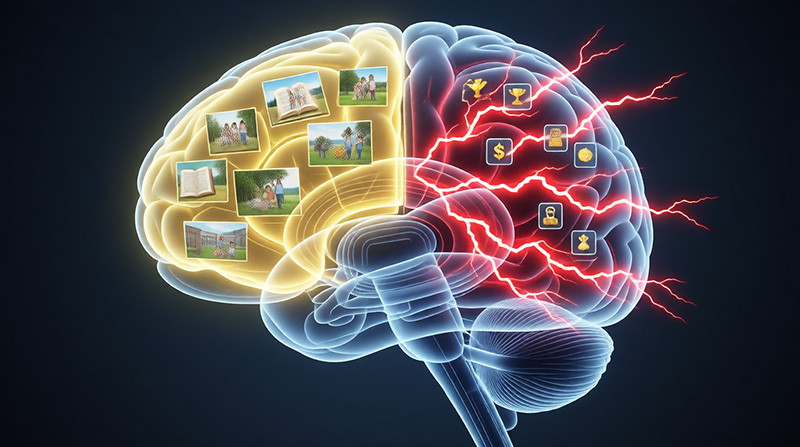
加州理工学院的脑部扫描揭示,人类大脑存在两个自我系统:
-
一个系统在前额叶皮层,负责理性思考,知道什么对我们真正重要。
-
另一个是边缘系统,作为“原始脑”,主导恐惧、贪婪和比较。
关键在于,焦虑时,边缘系统的反应速度是前额叶的3倍。 这就是为什么我们明知重要,却总做不到。
更具体地说:
-
意义的自我:负责长期叙事、价值排序,解读“我是谁”、“想成为什么人”。它更靠近前额叶,执行控制、反思等功能。
-
生存的自我:负责扫描威胁、追求即时奖励、比较地位、争夺资源和控制感。当环境压力增大时,更靠近边缘系统的它会天然夺取大脑主导权。
可以说,意义的自我偏理性,生存的自我则更偏向“兽性”,即人的原始属性。
四、生存模式如何劫持你的人生?
我们的生存自我是一个更古老、更省能量的系统。大脑天然喜欢节能。而我们的意义系统更耗能、更缓慢,需要更多安全感和空间才能启动。
当我们所处的环境充满焦虑、竞争、缺钱、关系不稳定时,你的大脑会优先将你切换到 “生存模式” 。因此,很多人的人生更容易被赚钱、效率、排名、外界期待等外部因素所牵引。
所以,“想做”和“在做”不一致并不罕见。临终时的大部分人后悔活成别人期待的样子,并非死亡带来了真理,而是它剥离了那些幻觉的支撑物。
外界的期待之所以能压过内心,是因为它有及时的奖惩系统(奖赏、金钱、地位、恐惧、羞耻),这些在我们的教育、职场、社会环境中广泛存在,并不断为生存自我“供能”。临终时,这些供能系统“断电”,意义的自我终于觉醒,拿回主导权,人生的遗憾便集中爆发于“我没活成我”这一点上。
五、痛苦、冲击与意义的觉醒
2021年《自然》杂志发现,大脑的元认知开关能抑制原始脑的活动。这也是冥想的科学原理——在冥想中,我们放下奖惩与评价系统,回归意义大脑,寻找生命真义。
芝加哥大学2020年的研究表明,经历过痛苦并挺过来的人,更容易找到人生意义。 你周围一定有这类案例:那些经历生病、离婚、家人变故、失业、亲人离世等痛苦的人,其生活方式和内心表达常会彻底改变。
这是因为,痛苦迫使人们直面 “什么真正重要” 这一核心问题。这符合心理学中 “创伤后成长” 的理论。重大冲击(如生育、重病)会让人重新评估生命优先级、人际关系和生活态度,思考自己真正相信什么。
这个机制在于:变化让旧有的“控制幻觉”破产了(例如“只要努力工作就能攀登职业阶梯”)。短期内,生存大脑会因焦虑、恐惧而更强。但一旦挺过危险阶段,人就会进入“重建叙事”的任务,必须重新回答:什么值得用剩余的生命去交换? 这也能解释为何有人重病后对事业的追求骤降,或家庭变故后全心投入公益。
六、解决方案:建立主动选择的机制
大脑里的两个自我并非非此即彼,关键是要建立一个能够主动选择的机制和结构。
我们无需试图消除生存的自我,它让我们更有资源、安全感和行动力,是刻在基因底层的反应模式。了解其机制后,我们要做的不是条件反射式的判断,而是主动选择。
-
当我们说 “我必须” 时,背后通常是恐惧、比较、羞耻,是生存的自我在支配。
-
当我们说 “我选择” 时,背后才是价值承诺和意义的自我。
如果我们的人生被“必须”推着走,终有一天会发现,自己似乎从未认真选择过。
七、用AI工具拿回人生主导权
那么,如何解决并拿回主导权?作为一个AI科技博主,我给大家一个用AI解决的实战方法。
我之前教过大家使用各种工具定制自己的小应用和智能体。对于我们识别出的生活难题,完全可以借助AI力量。为此,我DIY了一个 “两个自我调度器” 的AI小工具。
我想用这个工具解决三个问题:
-
识别模式:帮助我识别当前的操作与执行,到底是意义大脑还是生存大脑在主导。如果是生存模式,那么在此阶段就不做重大决定。
-
拆解意义:将我认为重要、有意义的事情,拆解成最具体、最小的动作,让大脑能在意义自我与生存自我之间进行更具体的切换。因为生存自我的执行力和反应速度更强,将意义拆解成小动作(例如“每天给孩子读30分钟故事”)会更具执行性。
-
定期复盘与对齐:定期帮我复盘,识别在一天的所有事务中,哪一刻我是被推着走的,哪一刻我是在做自己真正想做的事。通过不断复盘与审视,真正让意义的大脑来主导我的往后余生。
通过理解大脑机制,并借助现代工具,我们完全有可能从“知道”走向“做到”,让行动与内心真正同频。

Wanting vs. Doing: Why Your Actions So Often Betray Your Inner Values
A neuroscience insight into the “two selves” — and how AI can help you choose better
Hello everyone, I’m Owen.
Have you ever had this experience? You know perfectly well what truly matters to you — your health, your family, learning, writing, or doing the things you genuinely care about. And yet every morning, almost automatically, your hand reaches for your phone. You start answering messages, chasing KPIs, worrying about income, money, comparisons, falling behind.
It’s not that you don’t know.
It’s that you can’t seem to act on what you know.
In today’s video, I want to share a key insight of mine: why what you want and what you do so often move in opposite directions.
1. Behind the phenomenon: a system design problem
When this happens, about 90% of the time it’s not really your fault. It’s not simply a lack of willpower. It’s more like a system architecture problem.
To explain this, I’ll look at how the brain actually works — because inside your head, there are essentially two versions of you operating at the same time. I’ll also talk about how, in the age of AI, we can use tools to help ourselves make better choices.
2. Deathbed truths and the irony of VR funerals
You may have heard this before: a hospice nurse who recorded the final words of thousands of patients noticed a clear pattern. At the end of life, people rarely regret not making more money or not working harder. The most common regret was:
“I lived my life according to other people’s expectations.”
What does that tell us?
It suggests that the things we obsessively chase right now may turn out to be utterly worthless when we look back on our lives as a whole.
In 2019, Stanford ran a “VR funeral” experiment. Participants attended their own funeral through virtual reality. When asked what they wanted written on their tombstones, they chose words like “a good father” or “someone who lived authentically.” In that moment, they clearly saw what truly mattered to them.
And yet, ironically, once they took off the VR headset and returned to real life, they went right back to worrying about material success.
That familiar phrase — “once I have enough money,” or “once I succeed” — reflects what neuroscientists see as a fatal design flaw in the brain: it always postpones meaning to the future. And that future may never arrive.
3. The brain at work: a war between two selves
When we look at this from a neuroscientific perspective, the conflict between thinking and doing becomes much clearer.
Brain scans from Caltech reveal that the human brain operates with two self-systems:
-
One system lives in the prefrontal cortex. It handles rational thinking and understands what truly matters to us.
-
The other is the limbic system, our “primitive brain,” which governs fear, greed, and comparison.
Here’s the key point: under anxiety, the limbic system reacts three times faster than the prefrontal cortex. That’s why we so often fail to act on what we know is important.
More specifically:
-
The Meaning Self
This self handles long-term narratives, values, and identity — questions like “Who am I?” and “What kind of person do I want to become?” It relies on the prefrontal cortex and supports reflection, self-control, and planning. -
The Survival Self
This self constantly scans for threats, seeks immediate rewards, compares status, competes for resources, and craves control. Under pressure, it naturally takes over.
In short, the meaning self is more rational; the survival self is closer to our animal instincts.
4. How survival mode hijacks your life
The survival self is older and far more energy-efficient. The brain prefers efficiency by default. The meaning system is slower, more energy-intensive, and requires safety and mental space to function.
When your environment is full of anxiety — competition, financial pressure, unstable relationships — your brain automatically switches you into survival mode. As a result, many lives end up being driven by money, efficiency, rankings, and external expectations.
This is why the gap between “what I want to do” and “what I’m actually doing” is so common. People regret living for others’ expectations not because death reveals truth, but because death strips away the illusions that once supported those expectations.
External pressures win because they come with immediate reward-and-punishment systems — money, status, fear, shame — deeply embedded in our education systems, workplaces, and society. These constantly fuel the survival self.
At the end of life, that power supply shuts down. The meaning self finally wakes up, takes control, and the regret crystallizes into a single realization: “I didn’t live as myself.”
5. Pain, disruption, and the awakening of meaning
In 2021, Nature published research showing that the brain’s metacognitive “switch” can suppress primitive brain activity. This is the scientific basis of meditation: by stepping away from reward and evaluation systems, we reconnect with the meaning-oriented brain.
A 2020 University of Chicago study found that people who endure pain and survive it are more likely to find meaning in life. You’ve probably seen this yourself — people who’ve experienced illness, divorce, job loss, family tragedy, or death often undergo profound inner changes.
That’s because pain forces us to confront a fundamental question: what truly matters? This aligns with the psychological concept of post-traumatic growth.
Major disruptions — childbirth, serious illness — shatter the old illusion of control (“If I just work hard enough, I’ll keep climbing”). Initially, the survival brain becomes even louder. But once the danger passes, people are forced into a task of narrative reconstruction: What is worth trading the rest of my life for?
This explains why some people lose interest in career ambition after serious illness, or devote themselves to service after family loss.
6. The solution: building a system for conscious choice
The two selves are not enemies. The goal isn’t to eliminate the survival self — it gives us resources, safety, and momentum, and is hardwired into our biology.
The key is to build a structure that enables conscious choice rather than reflexive reaction.
When we say “I must,” we’re usually being driven by fear, comparison, or shame — the survival self in control.
When we say “I choose,” that’s value-based commitment — the meaning self speaking.
If your life is constantly pushed forward by “musts,” one day you’ll realize you never truly chose it.
7. Using AI to reclaim agency over your life
So how do we actually take back control? As an AI creator, I want to offer a practical solution using AI tools.
I’ve previously shown how to build personal apps and agents. Once we clearly identify the problem, AI can absolutely help. I built a small tool I call the “Two-Selves Scheduler.”
It helps me in three ways:
-
Pattern recognition
It identifies whether my current actions are being driven by the meaning brain or the survival brain. If I’m in survival mode, I avoid making major decisions. -
Breaking meaning into actions
It breaks what I find meaningful into the smallest concrete steps. Since the survival self executes faster, translating meaning into actionable micro-tasks (like “read to my child for 30 minutes a day”) makes follow-through much more likely. -
Regular review and realignment
It helps me review my day — when I was being pushed by external pressure, and when I was doing what I genuinely wanted. Over time, this allows the meaning brain to truly guide the rest of my life.
By understanding how the brain works — and using modern tools wisely — we can move from knowing to doing, and finally bring our actions into alignment with who we truly are.