看美剧绝望主妇学英语:当闺蜜当着面亲吻老公

在《绝望的主妇》第二季第11集的这个场景中,故事发生在一场热闹的邻里派对上。主妇们、她们的丈夫与朋友们聚在一起喝酒、聊天、回忆青春。开场旁白指出:看似简单的“吻”,实际上会因给出的人、接受的人、甚至旁观的人不同,而具有完全不同的含义。 这一主题贯穿整段剧情。
在派对的玩笑中,Gaby 为了活跃气氛、取笑 Tom 过去是“乐队书呆子”,便开玩笑地给了他一个夸张的大吻。虽然在场的人都觉得很搞笑,但这突如其来的吻却让 Lynette 有些不自在。她虽然信任丈夫,但看到一位魅力十足、曾是模特的 Gaby 亲吻自己的丈夫,即便只是玩笑,也让她产生了轻微的吃醋和不安。这种微妙的界线让原本亲密的朋友间出现了一丝不易察觉的紧张。
与此同时,派对上也出现了其他邻里线索,如神秘的 Applewhite 一家,以及 Bree 对他们“古怪得可疑”的评价。随着聚会结束、人们开始收拾残局,旁白再次强调主题:吻的意义因人而异,其影响不仅来自“亲吻的人”的用意,也来自“看到它的人”的感受——这一点也为接下来的人际误会与情绪冲突埋下伏笔。
Narrator: Kisses are such simple things, 亲吻是如此简单的事,
——>> we hardly notice them. 我们很少留意它们。
——>> But if we paid more attention, 但如果我们多加留意,
——>> we’d see that each kiss conveys a meaning all its own. 就会发现每个吻都传递着它独有的含义。
——>> For example, 例如,
——>> some can say, “I’m so happy to see you.” 有些吻在说:“见到你真高兴。”
Gaby: Or, “I didn’t realize you’d be here.” 或者,“没想到你会在这儿。”
——>> Bye. 再见。
Tom: Or, “honey, it’s time to stop drinking.” 或者,“亲爱的,该别喝了。”
Narrator: The trick is in knowing how to tell the difference. 关键在于懂得如何区分。
Gaby: So I finally said, if I’m head cheerleader, 所以我最后说,如果我是啦啦队长,
——>> then nobody wears panties. 那谁也不许穿内裤。
The Crowd: Yeah! 耶!
Karl: I just want you to know as a former member 我只想让你知道,作为我高中军乐队的前成员,
——>> of my high school marching band, I would’ve appreciated that. 我会很感激这一点的。
Gaby: Wait a second, you were a band geek? 等等,你以前是乐队书呆子?
——>> Oh, I don’t believe it. 哦,真不敢相信。
——>> What did you play? 你演奏什么乐器?
Lynette: He played the tuba. I have pictures. 他吹大号。我有照片。
Gaby: The tuba, huh? 大号,哈?
Tom: Yeah, go ahead, come on, come on, get your licks in, go ahead. 是啊,来吧,快,快,趁机取笑我吧,尽管来。
Get one’s licks in:To get your licks in means: to take your chance to criticize, attack, or push back against someone—before the moment passes. (在机会消失之前,抓住时机反击、表达不满、提出批评或给出自己的意见。原义来自“打架时先挥几拳”,现在多用于比喻“抓住机会反击或表达立场”。)
Gaby: No, no, not at all. As a matter of fact, 不,不,完全没有。事实上,
——>> all of my secret crushes were on the band geeks. 我所有暗恋的对象都是乐队书呆子。
Tom: Come on, I know you cheerleader types. 得了吧,我知道你们啦啦队那种人。
——>> You wouldn’t have said “boo” to guys like me. 你们才不会对我这样的人说半句话。
——>> No, you were more interested in the guys like – like this. Now, 不,你对像——像这样的男人更感兴趣。那么,
——>> I take it you didn’t play the tuba. 我猜你没吹过大号吧。
Karl: No, I didn’t. 不,没有。
Tom: All I know is, I was a lonely, insecure tuba player. 我只知道,我曾是个孤独、缺乏安全感的大号手。
——>> Girls like Gabrielle would just rip my heart out. 像加布丽尔这样的女孩只会伤透我的心。
The Crowd: Aw. 噢。
Tom: I didn’t even have my first kiss until I was 18. 我甚至直到18岁才有了初吻。
Karl: 18? – -18岁?
Tom: Pathetic, I know. 可悲,我知道。
Gaby: Poor baby. I would’ve kissed you. 可怜的孩子。我当时会吻你的。
Tom: No, you wouldn’t have. 不,你才不会。
Gaby: Yes, I would have. 会的,我会的。
Tom: No, you wouldn’t have. And it’s okay, Gaby. 不,你不会的。没关系的,盖比。
——>> Those scars healed a long time ago. 那些伤痕早就愈合了。
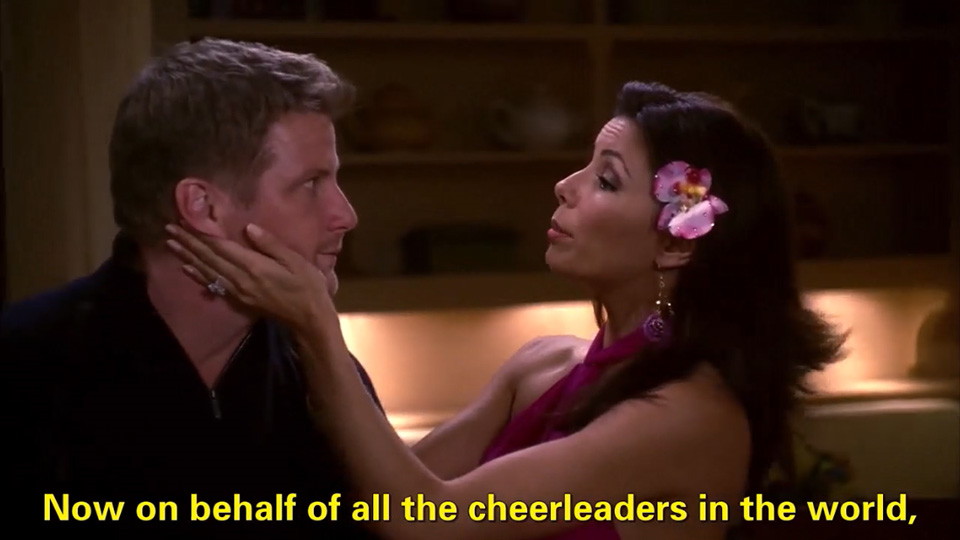
Gaby: Oh, for God sakes, come here. 哦,看在上帝的份上,过来。
——>> Now on behalf of all the cheerleaders in the world, 现在我代表全世界所有的啦啦队员,
——>> forgive us. 原谅我们。
The Crowd: Oh, yeah! Whoo! 哦,耶!呜!
Narrator: Yes, kisses mean different things to different people. 是的,吻对不同的人意味着不同的事。
——>> Ultimately, the meaning depends on the one who does the kissing… 最终,其含义取决于亲吻的人……
The Crowd: Wowie. Cheers. 哇哦。干杯。
Narrator: And the one who sees it happen. 以及看到它发生的人。
——>> After every party comes the time for cleaning. 每次派对过后,便是清理之时。
——>> We attend to the champagne that was spilled, 我们处理洒出的香槟,
——>> the knickknacks [‘nɪknæk] that got broken, the food that went uneaten. 打碎的小饰品,没吃完的食物。
Gaby: Oh, here, let me take that. 哦,给我,让我来拿。
Narrator: And whatever other messes need cleaning up. 以及其他任何需要清理的烂摊子。(承上启下)
Lynette: So, uh, Gaby… 那么,呃,盖比……
——>> you know that thing you and Tom did tonight? The – the kiss? 你知道你和汤姆今晚做的事吗?那——那个吻?
Gaby: Was that hysterical? The look on Tom’s face! 是不是很搞笑?汤姆脸上的表情!
Lynette: Yeah. I know this sounds silly, but…it kind of bugged me. 是啊。我知道这听起来很傻,但是……这让我有点不爽。
Sth bugged someone:it is a common, informal expression meaning something irritated, annoyed, bothered, or mildly upset a person. It describes a state of lingering, low-grade frustration rather than intense anger. (短语 “it bugged someone” 是一个常见、非正式的表达,意思是 某事惹恼、烦扰、困扰或轻微惹怒了某人。 它描述的是一种持续的、低强度的烦恼情绪,而非强烈的愤怒。)
日常对话:
“The way he kept interrupting me during the movie really bugged me.” (他看电影时不停地打断我,这让我很不爽。)
“It bugged her all day that she couldn’t remember where she’d left her keys.” (她一整天都因为想不起钥匙放哪儿了而心烦意乱。)
商务情境:
“It bugs the senior management that the project is constantly over budget without clear justification.” (项目不断超支却没有明确理由,这让高级管理层非常困扰。)
“While I agreed with the decision, the lack of transparency in the process really bugged me.” (虽然我同意这个决定,但过程中缺乏透明度确实让我感到不满。)
Gaby: You’re not serious. 你不是认真的吧。
Lynette: Yeah, I am. I don’t- I don’t want to make a big deal out of it, 不,我是认真的。我不想——我不想小题大做,
——>> but, uh, could you maybe not do that again? 但是,呃,你以后能不能别再那样做了?
Gaby: Okay. 好吧。
Lynette: Thanks. Okay. 谢谢。好了。
Susan: Hey, what happened to the Applewhites? I thought you were gonna invite them. 嘿,阿普尔怀特一家呢?我以为你会邀请他们。
Bree: I did. Betty never R.S.V.P.’d. 我邀请了。贝蒂从没回复。(ChatGPT 说: R.S.V.P. 是法语 “Répondez s’il vous plaît” 的缩写。意思相当于:Please respond.)
Edie: What do you guys think about the Applewhites? 你们觉得阿普尔怀特一家怎么样?
Susan: I like ’em, very nice. 我喜欢他们,人很好。
——>> Very… 非常……
Bree: interesting. 有趣。
Susan:Right, interesting. 对,有趣。
Edie: Hmm, they weird me out, too. 嗯,他们也让我觉得怪怪的。
Susan: Well, that’s not what we’re saying. 嗯,我们不是那个意思。
Bree: not exactly, anyway. 不完全是,反正。
Gaby: You know, we were just having fun, 你知道,我们只是闹着玩,
——>> entertaining the crowd. 娱乐一下大家。
Lynette: Oh, sure, but… 哦,当然,但是……
——>> but maybe next time you could try juggling [‘dʒʌglɪŋ] instead. 但也许下次你可以试试杂耍。
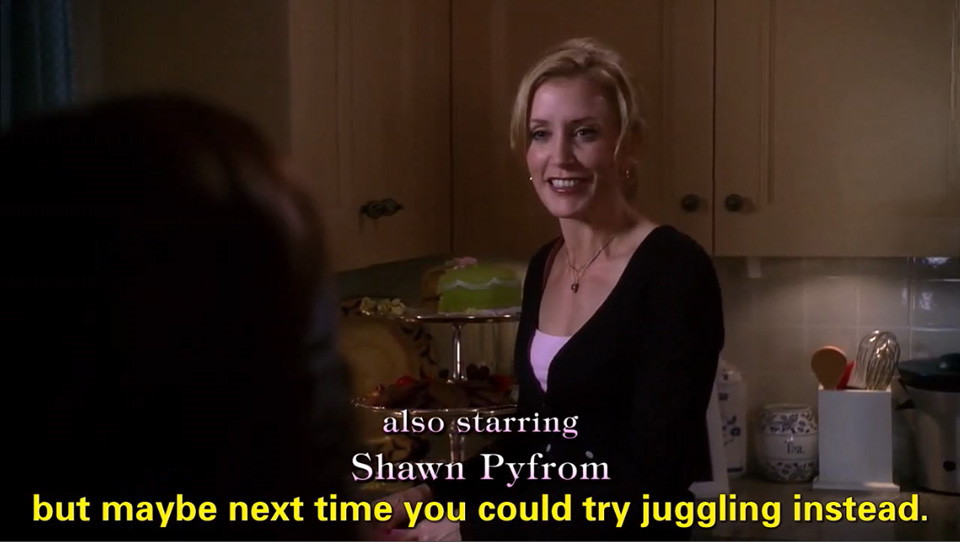
Edie: What’s going on? 怎么了?
Lynette: Nothing. 没事。
Edie: Really? I sense a little tension. 真的吗?我感觉有点紧张的气氛。
Lynette: No, no tension. 不,没有紧张。
Gaby: What? 什么?
——>> You make it sound like… 你说得好像……
——>> I was making a pass at your husband. 我是在向你丈夫示好似的。
——>> And that’s just a little bit insulting. 这有点侮辱人。
Lynette: I just said it bugged me. 我只是说这让我不爽。
——>> Why is that a problem? 这有什么问题吗?
Edie: Is this about that kiss? 是因为那个吻吗?
Susan: What kiss? 什么吻?
Edie: Oh, you were in the living room. 哦,你当时在客厅。
——>> Gaby planted a big, wet kiss on Tom… as a joke. 盖比给了汤姆一个又大又湿的吻……开玩笑的。
Plant:the act of placing or delivering something—typically a kiss, a punch, or an idea—in a forceful, deliberate, and often unexpected or abrupt manner. It carries a sense of finality and impact.
Key connotations:
Force & Deliberation: It’s not a gentle or hesitant action. The kiss is given with purpose and energy.
Suddenness/Abruptness: The action often happens quickly and catches the recipient off guard.
Physicality & Contact: Emphasizes the physical act of making firm contact.
Humorous or Dramatic Effect: Frequently used in storytelling or casual speech to create a comic or vivid image.
The phrase “planted a kiss” paints a picture of Gaby decisively and physically pressing the kiss onto Tom’s face, much like one might plant a flag in the ground to claim territory. The addition of “big” and “wet” further exaggerates the action for humorous effect.
在此语境中,“to plant”(此处译为“印上”、“狠狠亲了一下”等) 是一个生动、非正式的动词,用于描述以强有力的、故意的、且通常出乎意料或突然的方式施加某物——通常是亲吻、拳头或想法。它带有一种果断和冲击力的意味。
核心涵义:
力度与故意性: 这不是一个温柔或犹豫的动作。这个吻是带着目的和能量给出的。
突然性/突兀性: 该动作通常发生得很快,让接受者猝不及防。
身体接触感: 强调发生实质性身体接触的动作。
幽默或戏剧效果: 常用于讲故事或日常口语中,以创造一种喜剧性或生动的形象。
短语 “planted a kiss” 描绘了一幅画面:盖比果断地、实实在在地把这个吻“按”在了汤姆的脸上,就像人们把旗帜插在地上以宣示主权一样。加上“big”(大的)和“wet”(湿的)进一步夸大了这个动作,以达到幽默效果。
He got so nervous during his speech that he just planted himself behind the podium and didn’t move a muscle. (他演讲时太紧张了,整个人就定在讲台后面,一动不敢动。)
Who planted the idea in your head that I was angry with you? I’m just tired. (是谁在你脑子里种下了我生你气的想法?我只是累了。)
Business Context Examples:
The automotive company announced plans to plant a new electric vehicle factory in the region, creating over 2,000 jobs. (该汽车公司宣布计划在该地区新建一座电动汽车工厂,将创造超过2000个工作岗位。)
The consultant suggested we plant a few positive stories about our corporate culture in the media to improve our employer brand. (顾问建议我们在媒体上安插/植入一些关于我们企业文化的正面报道,以提升雇主品牌形象。)
——>> It was hilarious. 特别好笑。
Gaby: You see? 明白了吧?
Bree: Yeah, but to be fair to Lynette, 是啊,但公平点说,站在勒奈特的角度,
——>> you are an ex-model. 你是个前模特。
——>> And surely it must have dawned on you that some women 你肯定也意识到,有些女人
——>> might prefer it if you didn’t kiss their husbands. 可能更希望你别吻她们的丈夫。
Lynette: That’s all I’m saying. 我就说这些。
Bree: Oh, you guys, we’re all friends. 哦,姐妹们,我们都是朋友。
——>> This isn’t something to get worked up over. 这不是什么值得激动的事。
“Get worked up” is a phrasal verb meaning to become emotionally agitated, anxious, or overly upset about something, often unnecessarily or disproportionately. It implies a state of heightened stress, anger, or excitement that may cloud judgment or affect one’s composure. (因某事变得情绪激动、焦虑或过分烦躁,通常指不必要的或过度的反应。它暗示一种压力、愤怒或兴奋的情绪高涨状态,可能影响判断力或镇定。)
Daily Conversation:
Don’t get worked up over a missed call—it was probably just a spam number.
参考翻译:别为一个未接电话心烦意乱了——很可能只是骚扰号码。
She always gets worked up before her kids’ school plays, even though they always do great.
参考翻译:每次孩子们的校园剧表演前,她总是紧张不已,尽管他们每次都表现得很棒。
Business Related:
There’s no need to get worked up before the client meeting; we’re well-prepared.
参考翻译:没必要在客户会议前自乱阵脚;我们准备得很充分。
He got worked up when the project deadline was moved up, but we managed to adjust the schedule calmly.
参考翻译:项目截止日期提前时他有些沉不住气,但我们还是从容地调整了计划。
Lynette: I’m not worked up. 我没激动。
Gaby: Me neither. 我也是。
In this scene from Desperate Housewives Season 2, Episode 11, the story takes place during a lively neighborhood party where the housewives, their husbands, and friends gather to relax, drink, and reminisce about their younger years. The episode opens with the narrator reflecting on how kisses, though simple, carry different meanings depending on who gives them and who witnesses them. This theme becomes the emotional thread of the scene.
Amid the party chatter, Gaby jokingly kisses Tom to cheer him up after teasing him about being a “band geek” in high school. While the crowd finds it hilarious, the moment unexpectedly triggers mild insecurity in Lynette, who—despite trusting her husband—feels uncomfortable seeing another woman, especially a glamorous ex-model like Gaby, kiss him so intimately, even as a joke. This sets off a subtle but real tension between the two friends, highlighting how fragile boundaries can be even within close friendships.
Meanwhile, the party also touches on other neighborhood dynamics, including the mysterious Applewhite family and Bree’s observation about their odd behavior. As the night winds down and the guests begin cleaning up, the narrator returns to her metaphor: kisses mean different things to different people, and their impact depends not only on intention but also on perception—foreshadowing the misunderstandings and emotional conflicts that follow.