

在奥斯汀的小说中,金钱不仅仅是账面上的数字,它是“浪漫之心的跳动节奏”,更是决定一个人在社交天梯上位置的“重力感应器”。要算清楚《傲慢与偏见》背景下的5000英镑值多少钱,我们需要从“现代购买力折算”和“当时的社会阶层定位”两个维度像切蛋糕一样精准地拆解:

1. 现代购买力:这笔钱值多少人民币?
根据来源资料提供的一个非常直观的参照系:奥斯汀时代的5英镑大约相当于今天的250英镑。
• 倍率计算: 这意味着当时的购买力大约是今天的50倍。
• 英镑折算: 5000英镑(当时) × 90 ≈ 450,000英镑(今天)。
• 人民币兑换: 这是一个来源之外的实时信息,我需要特别说明:按照目前(2024年)英镑兑人民币约1:9.2的汇率计算(此汇率信息来自外部,请你独立验证),当时的5000英镑大约相当于现在的 400万人民币左右。
2. 阶层定位:5000英镑在当时意味着什么?
在奥斯汀的“语言机器”里,数字的含义取决于它是“年收入(Income)”还是“总财产(Fortune)”。我们可以通过几个形象的比喻来理解:
• 如果是年收入(年薪5000英镑):你是顶级“钻石王老五” 在小说开头,那位“单身、多金、人人想嫁”的宾利先生,每年的收入就是4000到5000英镑。这不仅意味着他能买得起华丽的马车、租得起昂贵的庄园,还意味着他能跻身于不需要工作的“有产阶层”。在当时,年入5000英镑属于社会顶层,可以轻松支撑一个庞大家庭的奢华生活,甚至还能在伦敦过社交季。
• 如果是总财产(5000英镑本金):你是“刚好体面的中产边缘” 《傲慢与偏见》中提到,班内特太太的陪嫁总共只有4000英镑,而班内特五姐妹最终将平分一笔5000英镑的信托基金。这笔钱通常会投资于年利率为4%或5%的政府国债。
◦ 利息计算: 5000英镑的总财产,每年产生的利息大约是200到250英镑。
◦ 生活水平: 年入250英镑左右是什么水平呢?来源告诉我们,200英镑是一个家庭维持“绅士体面”的最底层门槛。这笔钱只能雇得起一个“全能女佣”,生活必须精打细算,绝对买不起马车。如果班内特五姐妹每人分到1000英镑,她们一年的生活费只有40英镑,这在当时被认为是非常“可怜的一点钱”。
在奥斯汀的世界里,金钱是“维持绅士 claims(主张)”的工具。5000英镑如果作为年薪,它是通往宾利那种奢华生活的门票(约230万人民币的年薪,但在那个时代意味着极高的社会地位);但如果作为总财产,它仅仅是像班内特五姐妹那样的女性在失去父亲庇护后,不至于流落街头或去做“相当于奴隶贸易”的家庭教师的最后一道防线。
既然我们聊到了金钱的魔力,你是否想知道,像达西先生那种“年入一万英镑”的巨富,在当时的社交圈里到底拥有一种什么样的“生杀大权”?
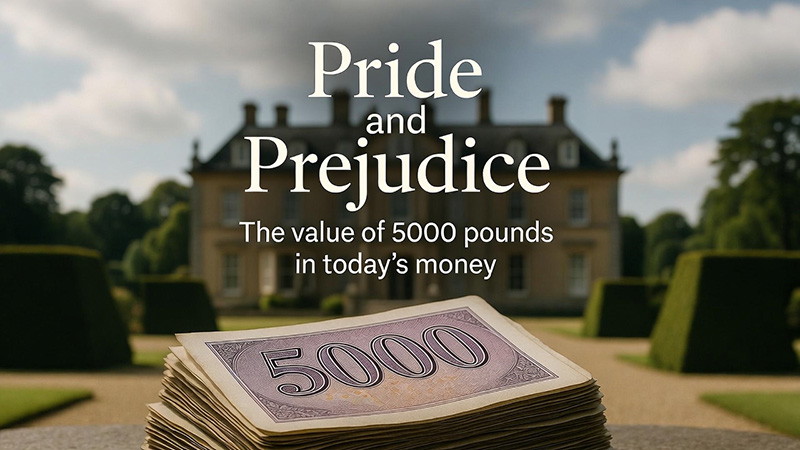
In Austen’s novels, money is far more than a figure on a ledger. It is the “rhythm of the romantic heart” and the “gravity sensor” determining one’s position on the social ladder. To grasp the true value of £5,000 in the world of Pride and Prejudice, we must dissect it with precision along two key dimensions: modern purchasing power and contemporary social standing.
1. Modern Purchasing Power: What is £5,000 Worth Today?
Based on historical references, a very intuitive benchmark exists: £5 in Austen’s time held a purchasing power roughly equivalent to £250 today.
-
Multiplier Calculation: This implies a 50x multiplier in purchasing power.
-
Historical to Modern Pounds: £5,000 (then) × 50 ≈ £250,000 (today).
-
Conversion to RMB: Please note: the following currency conversion is based on external real-time data and should be independently verified.
Using an approximate 2024 exchange rate of £1 : ¥9.2, the historical £5,000 translates to around ¥2.3 million RMB in today’s terms.
2. Social Positioning: What Did £5,000 Mean in Austen’s Era?
Within Austen’s “language machine,” the meaning of a sum depends entirely on whether it is Annual Income or Total Fortune. Let’s understand this through illustrative analogies.
-
If it’s an Annual Income (Salary of £5,000): You are a Top-Tier “Most Eligible Bachelor.”
At the novel’s opening, the “single, wealthy, and highly sought-after” Mr. Bingley has an income of £4,000 to £5,000 per year. This signifies not only the ability to afford a fine carriage and rent an expensive estate but also entry into the “leisured propertied class.” An income of £5,000 p.a. placed one at the very pinnacle of society, capable of supporting a large family in luxury and funding a full London social season. -
If it’s Total Capital (A Fortune of £5,000): You are “Barely Genteel on the Middle-Class Fringe.”
In Pride and Prejudice, Mrs. Bennet’s dowry totaled only £4,000, and the five Bennet sisters are to share a £5,000 trust fund. Such capital was typically invested in government funds yielding around 4-5% interest.-
Interest Calculation: A £5,000 fortune would generate roughly £200 to £250 in annual interest.
-
Standard of Living: What did £250 p.a. afford? Historical context tells us that £200 was the absolute minimum threshold for a family to maintain a “genteel” appearance. It would cover a single “maid-of-all-work” and necessitate frugal living—a carriage was out of the question. If the £5,000 were split five ways, each Bennet sister would have a £1,000 portion, yielding a meager £40 per year. This was considered a “pitifully small” sum, insufficient for independent survival.
-
The Final Verdict
In Austen’s world, money was the instrument for maintaining “gentle claims.”
As annual income, £5,000 was a ticket to a Bingley-style life of luxury (akin to a ¥2.3 million RMB salary today, but with vastly greater social prestige in that era).
As total capital, it represented the last line of defense for women like the Bennet sisters—a buffer against destitution or the dire fate of becoming a governess (a role often compared to a form of “social slavery”) after their father’s death.
**Since we’ve uncovered the power of pounds… are you curious to know what kind of near-absolute social power a colossal income of £10,000 a year—like Mr. Darcy’s—commanded in the drawing rooms and ballrooms of the time?