
从编剧视角看美剧《欲望都市》学英语:万字笔记

凯莉·布雷萧被困住了。不仅是陷入了约会荒,更是跌入了创作深渊,深到她得去挖掘六年前与“凉鞋男”的短暂约会来充当专栏素材。当她的朋友们提供着不温不火的支持(而且说实话,并没全在看她的文章)时,她的职业恐慌达到了顶点:“我不是没人睡。我是快要被炒了。”寻找完美薯条的旅程从未如此黯淡。
就在这时,萨曼莎投下了一颗比她点的水果拼盘更重磅的炸弹:她和理查德复合了,就是那个她们曾一起“深情”诅咒其早死的连环出轨男。现场一片哗然。她的辩护是什么?一堂重新定义“宽限期”的合理化大师课。他当时“害怕了”,她解释道——这个理由让米兰达气得嘟囔“害怕是躲在被子底下,不是躲在别人两腿之间”,而凯莉则在脑海里草拟起无比犀利的专栏标题。
这场戏是一杯融合了友谊、坦诚与华丽自我欺骗的闪亮鸡尾酒。它关乎个人身份与职业身份混乱的交集,关乎我们有时为男性责任感设定的低标准,也关乎那种让你的挚友能当面叫你“绝望女人”却依然不离不弃的忠诚——而这一切,都发生在服务员还没上来买单之前。纯粹、未加稀释的纽约友情戏剧。
Ladies and gentleman, brunch is served—with a side of existential crisis and questionable life choices! Gather ‘round the table for a quintessential Sex and the City moment where mimosas meet melodrama, and writer‘s block collides with romantic regression.
Carrie Bradshaw is stuck. Not just in a dating dry spell, but in a creative abyss so deep she‘s mining six-year-old flings with “sandal guys” for column fodder. As her friends offer lukewarm support (and frankly, aren‘t all reading her work), her professional panic reaches a fever pitch: “I‘m not getting laid. I‘m getting laid off.” The quest for the perfect French fry has never felt so bleak.
Enter Samantha, dropping a bombshell smoother than her fruit plate order: she‘s back with Richard, the serial cheater whose “death” the group had lovingly plotted. Cue the collective gasp. Her defense? A masterclass in rationalization that redefines the term “grace period.” He was “scared,” she explains—a justification that leaves Miranda sputtering about hiding under covers versus between legs, and Carrie drafting brutally honest column titles in her head.
This scene is a sparkling cocktail of friendship, frankness, and fabulous self-delusion. It‘s about the messy intersection of personal and professional identity, the low bar we sometimes set for male accountability, and the unwavering loyalty that lets your best friends call you a “desperate woman” to your face—all before the waiter even brings the check. Pure, uncut NYC friendship drama.
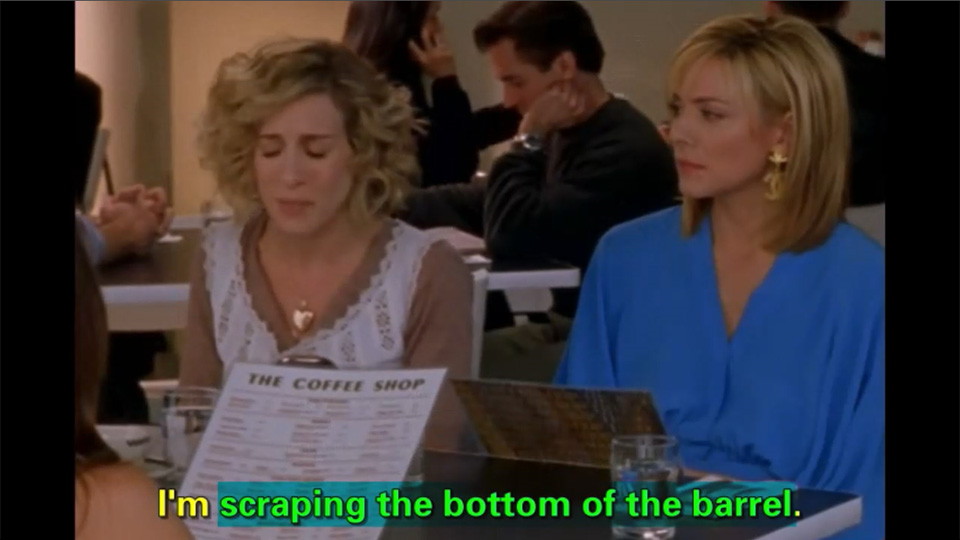
Carrie: The worst thing about not being in a relationship… 单身最糟糕的一点在于……
——>> is when your job is to write about being in a relationship. 你的工作恰恰是书写恋爱关系。
——>> Remember that guy who wore sandals, Randal the sandal guy? We went on a couple of dates. 还记得那个穿凉鞋的家伙吗,凉鞋男兰德尔?我们约会过几次。
Miranda: Like six years ago? 得是六年前的事了吧?
Carrie: Yeah. Is that anything? 对。这能算写作素材吗?
Charlotte: His name was Randal? 他叫兰德尔?
Carrie: No, I‘m scraping the bottom of the barrel here, ladies. 不(不只是名字问题),姑娘们,我这可是在“桶底刮渣”了(指灵感枯竭)。
——>> Last week I wrote about my search for the perfect French fry. 上周我写了篇寻找完美薯条的文章。
In essence, the “perfect French fry” is the antithesis of a meaningful quest. It’s a metaphor for the creative, professional, and personal dead end where Carrie finds herself—chasing trivial perfection because the substantial things she truly wants feel out of reach.
本质上,“完美薯条”是对有意义追求的反面。它是一个隐喻,代表了凯莉发现自己所处的创意、职业和个人 dead end(死胡同)——因为真正渴望的实质性的东西似乎遥不可及,而去追逐琐碎的完美。
Miranda: It was cute. 写得挺俏皮的。
Carrie: French fries. 薯条。
——>> You didn‘t read it, did you? 你其实没看,对吧?
Miranda: I don‘t always have time to read your column. 我又不是总有时间看你的专栏。
Carrie: OK, then. Wow! Even my friends find me irrelevant. 好吧。哇哦!连我最好的朋友都觉得我无关紧要了。
Charlotte: Hey, I read it every week. 嘿,我每周都看。
Miranda: You have a little man hanging from your breast. 那是因为你有个“小男人”挂在胸前(指在哺乳)。
Charlotte: What else are you gonna do? 不然喂奶时还能干嘛?
Miranda: Eat. 吃东西。
Carrie: I‘m in a dating desert. They‘ll have to change the name of my column to “…And The City”. Or they‘ll cancel it. 我正处于约会荒漠。他们干脆把我的专栏名改成“……和城市”算了。不然就得停掉它。
“In a * desert” is an idiomatic metaphor meaning: 👉 being in a situation where there is a severe lack of something important. (处于某种资源极度短缺、匮乏的状态。
“*”代表缺的那个东西,比如爱情、创意、资金、人才等。)Daily Conversation (日常交流)
I’ve been in a love desert for months—no dates, no sparks, nothing.
我这几个月简直身处“爱情荒漠”——没约会、没心动、啥都没有。This town is such a food desert; you can’t even find a decent sandwich.
这个镇子就是个“美食荒漠”,连像样的三明治都找不到。
Business Context (商务场景)
Our team is in an idea desert lately; no one has pitched anything fresh.
我们团队最近陷入“创意荒漠”,没有人提出任何新点子。The region has become a talent desert, making recruitment almost impossible.
这个地区已经成了“人才荒漠”,招聘几乎不可能。
Samantha: You‘re on the side of a bus, for God‘s sake. 拜托,你的脸都印在公交车侧面了(指专栏宣传广告)。
Carrie: Why did my editor call? He never calls. 为什么我编辑会打电话来?他从不主动打电话的。
在《欲望都市》该情境中,凯莉的这句台词 “编辑为什么打电话给我?他从不主动打电话的。” 是一个高度浓缩的职业危机信号,具体指向以下几个层面:
1. 直接情节指涉:对专栏生存的恐慌
凯莉的专栏《性与城市》是她在纽约生活的经济与身份支柱。在当时的媒体环境中(尤其是传统报纸专栏),编辑的沉默通常意味着“一切照常”,而突然的主动来电往往预示着重大变动——可能是警告销量下滑、内容调整,甚至可能是栏目取消的前兆。她的恐慌源于对行业规则的直觉:无事不登三宝殿。
2. 心理潜台词:对自身价值的深度不安
这句话暴露了凯莉长期以来的不安全感:
“他从不打电话” 说明编辑平日与她保持职业距离,默认她的稿件会按时交付、质量稳定。
突如其来的联系 打破了这种“稳定的忽视”,让她立即联想到自己最近的状态:
写作灵感枯竭(只能写“薯条”和“袜子抽屉”)
情感生活空白(“约会荒漠”)
怀疑自己的话题已脱离读者兴趣
她内心的恐惧公式是:编辑来电 = 我的工作出了问题 = 我失去了价值。
3. 行业隐喻:文化消费品在萧条期的脆弱性
此场景发生在经济低迷的背景下(她刚提出“这不是当奶油花的好时机”)。编辑的电话成为整个行业收缩压力的具体化身:
报社可能面临预算削减、版面调整。
作为“非必需品”(奶油花)的时尚情感专栏,往往是首批被审视的对象。
她的焦虑本质上是个体创作者在资本波动下的无力感:一道突然的电话铃声,足以摇撼她的职业生涯。
4. 与前后情节的闭环逻辑
前因:她已多次抱怨专栏素材枯竭、读者流失(包括朋友也不认真读)。
后果:这句话直接引出她下一句更直白的恐惧:“我不是没人约会,我是要被解雇了。”(I’m not getting laid. I’m getting laid off.)
戏剧功能:编辑从未出现的“幽灵感”,反而强化了权力的压迫性——她始终活在一种“被评判却无法沟通”的焦虑中。
总结:一个电话背后的冰山
凯莉对一通寻常来电的过度解读,正是自由职业者与创意工作者生存状态的缩影:
职业命运悬于他人(编辑/市场)的一念之间。
稳定的假象随时会被打破,且警告信号往往微小而突然。
她的幽默感(“他从不打电话”)实则是用自嘲掩盖窒息感。
这句台词之所以经典,是因为它用生活化的场景(接电话)揭示了创意经济的残酷规则:你的价值永远由下一个电话决定,而你永远在等待铃声响起的恐惧中。
1. Immediate Plot Signal: Fear for the Column’s Survival
Carrie’s column “Sex and the City” is her financial and professional lifeline in New York. In the traditional media landscape depicted, an editor’s silence usually means “business as usual,” but an unsolicited call breaks that norm—often signaling urgent news: slipping ratings, a content overhaul, or even cancellation talks. Her panic stems from an industry instinct: no call is good news, but an unexpected call is almost always bad news.
2. Psychological Subtext: Deep-Seated Insecurity
The line reveals Carrie’s chronic professional vulnerability:
“He never calls” implies a distant, transactional relationship where her work is taken for granted.
The sudden outreach shatters that uneasy stability, forcing her to confront what she already suspects:
Her creative drought (reduced to writing about “fries” and “sock drawers”)
Her romantic drought (“dating desert”)
Her fading relevance as a voice for modern women
Her internal equation is: Editor’s call = My work is in trouble = I am failing.
3. Industry Metaphor: The Fragility of “Cultural Luxury Goods”
This scene unfolds against a backdrop of economic anxiety (she just said, “This is not a good economy in which to be whipped cream”). The editor’s call becomes the embodied pressure of a contracting industry:
Newspapers may be cutting budgets or streamlining sections.
A “luxury” lifestyle column—like whipped cream—is often among the first to be scrutinized.
Carrie’s fear mirrors that of every creative in a volatile market: a single ring can destabilize her entire career.
4. Narrative Function: Tightening the Screws
Setup: She has repeatedly confessed to running out of material and losing reader engagement (even her friends don’t read her faithfully).
Payoff: This line leads directly to her next, more explicit dread: “I’m not getting laid. I’m getting laid off.”
Dramatic irony: The editor’s phantom presence—never seen, rarely mentioned—heightens the sense of opaque, powerful forces controlling her fate.
Why This Line Resonates
Carrie’s overinterpretation of a mundane phone call captures the precarity of creative freelancers:
Your career hangs on someone else’s decision (an editor, the market).
The illusion of stability can shatter with one notification.
Her humor (“He never calls”) masks a suffocating anxiety.
It’s a masterful stroke of character writing: in a single question, Carrie voices the silent terror of every artist, writer, or creator whose worth is decided by forces they can’t control—always waiting for the call that might end everything.
——>> I‘m not getting laid. I‘m getting laid off. 我不是没人睡。我是快要被炒了。
Samantha: You‘re not getting laid off. 你不会被炒的。
Carrie: Samantha, I don‘t know if you read the rest of the paper, but these are troubled times. People with real jobs are getting laid off. 萨曼莎,我不知道你们看不看报纸的其他版面,但现在是艰难时期。有正经工作的人都在被裁员。
——>> This is not a good economy in which to be whipped cream. (Bells and whistles)经济不景气的时候,当个“奶油花”(指装饰性、非必需的内容)可不好过。【whip eggs:打散鸡蛋】
Carrie’s remark “This is not a good economy in which to be whipped cream” is a layered, metaphorical critique that perfectly encapsulates her professional anxiety and the show’s broader social commentary. (凯莉的这句 “经济不景气的时候,可不好当奶油花” 是一个层次丰富、充满隐喻的批判,精准地概括了她的职业焦虑,也体现了本剧更广泛的社会评论性。)
1. Literal vs. Metaphorical Meaning:
Whipped Cream: In a culinary context, whipped cream is a luxurious, decorative, non-essential garnish. It’s the first thing to be removed or forgone when cutting costs or prioritizing sustenance. (奶油花: 在烹饪语境中,奶油花是一种奢华的、装饰性的、非必需的配料。在削减成本或优先考虑生存需求时,它是最先被去掉或舍弃的东西)。
Applied to Carrie/Her Work: Carrie likens herself—and by extension, her column about love, sex, and relationships—to this garnish [‘ɡɑːnɪʃ] . She is not “essential nourishment” (like a “real job” in finance, law, or healthcare). Her writing is seen as a frivolous [‘frɪvələs] luxury, a cultural dessert.
- 应用于凯莉/她的工作: 凯莉将自己——以及延伸开来,她关于爱情、性与关系的专栏——比作这种装饰品。她不是“必需的营养”(如金融、法律或医疗等“正经工作”)。她的写作被视为一种轻浮的奢侈品,一种文化甜点。
2. Socio-Economic Commentary: ( 社会经济评论)
The line is a sharp observation about economic downturns and cultural values. In a booming economy, society can afford to indulge in and value “whipped cream”—art, commentary, entertainment, and lifestyle journalism. During a recession (“troubled times”), the cultural mindset shifts toward austerity [ɒ’sterəti] , practicality, and survival. What is deemed “essential” narrows dramatically, leaving fields like Carrie’s exposed and vulnerable. Her fear of her column being canceled is a fear of her life’s work being deemed socially and economically irrelevant.这句话是对经济衰退与文化价值观的犀利观察。在经济繁荣时期,社会可以负担并重视“奶油花”——艺术、评论、娱乐和生活方式新闻。而在经济衰退(“艰难时期”),文化心态会转向紧缩、实用和生存。被定义为“必需”的范围急剧缩小,使得像凯莉所从事的领域暴露在外、脆弱不堪。她对专栏被取消的恐惧,正是对自己毕生工作被判定为社会性、经济性无关紧要的恐惧。
3. Personal & Professional Identity Crisis: (个人与职业身份危机)
This statement is the core of Carrie’s panic. It’s not just about job security; it’s an existential threat to her identity. If the world decides it has no room for “whipped cream,” then she, as the author of that “whipped cream,” has no place. This forces her into a desperate and comically futile search for more “substantial” topics (e.g., the perfect French fry, socks), highlighting the absurd pressure on creatives to justify their worth in purely utilitarian terms.这个陈述是凯莉恐慌的核心。这不仅仅是工作保障问题,更是对她身份存在的威胁。如果世界决定不再需要“奶油花”,那么她,作为这“奶油花”的制造者,也就没有立足之地了。这迫使她陷入一种绝望且滑稽徒劳的寻找,去追求更“有分量”的话题(例如,完美的薯条、袜子),凸显了创意工作者在纯粹功利性条件下证明自身价值的荒谬压力。
4. Irony & Humor: (反讽与幽默)
The genius of the line is its self-deprecating [‘deprəkeɪt] humor and irony. Carrie delivers this insightful, economically sound analysis about her own impending obsolescence. She is both the commentator and the subject being commented on. The humor comes from the vivid, slightly ridiculous metaphor that is nonetheless painfully accurate.这句话的精妙之处在于其自嘲的幽默与反讽。凯莉用一个生动形象、略显荒诞却又无比准确的隐喻,对她自己即将过时的命运做出了这番富有洞察力、符合经济逻辑的分析。她既是评论员,又是被评论的对象。
Comment: (评论)
Carrie’s quip is more than just a witty one-liner; it is a micro-thesis on the precarious position of cultural production. It brilliantly captures the vulnerability of those whose work revolves around meaning, pleasure, and connection rather than tangible goods or essential services. Her anxiety foreshadows contemporary debates about the value of the humanities, the arts, and “soft” skills in a profit-driven world. In essence, she is asking: When times get tough, is there still room for what makes life sweet, or do we retreat to a diet of pure utility? Her fear is that the answer, at least in the short term, is the latter.凯莉的俏皮话远不止是一句机智的口头禅;它是一篇关于文化生产脆弱地位的微型论文。它精彩地捕捉了那些工作围绕意义、愉悦和情感连接而非实体商品或必需服务的人们的脆弱性。她的焦虑预示了当代关于人文、艺术以及“软”技能在利益驱动世界中的价值的辩论。本质上,她是在问:当时局艰难时,生活是否还需要点缀甜蜜,抑或我们只能退守纯粹实用的“饮食”? 她的恐惧在于,答案(至少在短期内)是后者。
以经济萧条期为背景,“寻求完美薯条”的隐喻可对应现实中人们转向低成本、高感官慰藉、具有象征性控制感的替代性追求。以下是具体例证:
一、消费降级中的“极致性价比”狂热
现象:消费者不再追逐奢侈品,转而沉迷于寻找“50元米其林套餐”“10元宝藏奶茶”“全网最低价临期食品”等极致性价比商品。
“完美薯条”逻辑:在无力负担“正餐”(如购房、旅行)时,通过挖掘“薯条”(低价小确幸)的细节完美感,获得对消费能力的象征性掌控。社交媒体上“薅羊毛攻略”的病毒式传播,正是集体化“薯条测评”行为。
二、文化消费的“碎片化奢侈”
现象:放弃演唱会、出国游等大型消费,转而投入:
沉浸式手游抽卡:花费小额资金反复抽取“完美角色”,用概率游戏替代现实成就感。
盲盒经济:通过收集低成本玩偶获得“隐藏款”的瞬间刺激,替代收藏艺术品等高端精神消费。
短视频“解压直播”:观看切香皂、洗地毯等重复性解压视频,用感官舒适填补情感空虚。
“完美薯条”逻辑:将有限资源投入可即时获得、且具备“完美标本”属性的碎片化娱乐,如同在快餐中追求“金黄酥脆的终极薯条”。
三、生产性娱乐的“匠人幻想”
现象:经济下行期,家庭烘焙、阳台种菜、手工编织等活动的爆发式流行。
“完美薯条”逻辑:
当职业晋升受阻(“正餐”匮乏),人们转而追求“做出完美戚风蛋糕”“种出比超市更甜的番茄”(“完美薯条”)。
这类活动将经济价值转化为“技艺价值”,通过对微观过程的极致控制,对抗宏观生活的失控感,宛如对一根薯条的形状、调味进行偏执性优化。
四、情感关系的“低风险代餐”
现象:
追星/虚拟偶像沉迷:将对现实亲密关系的高投入需求,转化为对偶像人设、“纸片人”的情感投射,追求“完美人设”的稳定慰藉。
宠物拟人化养育:为宠物定制膳食、服装、生日派对,将养育子女的高成本转化为对“完美毛孩子”的精细化经营。
“完美薯条”逻辑:用低风险、高可控性的情感替代品,置换复杂真实的人际关系,如同放弃烹饪盛宴而专注于调制一包薯条的蘸酱。
五、知识焦虑的“浅层积累”
现象:付费购买大量碎片化知识课程(如“10分钟读懂哲学”“每天听本书”),却难以进行系统深度学习。
“完美薯条”逻辑:在无力实现职业突破(“知识正餐”)时,转而积累“知识零食”的虚假饱腹感,追求“收藏即掌握”的错觉,如同收集不同品牌薯条评测却从未下厨。
Here is a breakdown of its metaphorical meanings:
1. Metaphor for Creative Desperation and Trivialization
The “perfect French fry” represents a subject that is inherently trivial, mundane, and a parody of her usual column material. Carrie’s iconic column explores the grand, dramatic, and universal themes of love, sex, and relationships (“He’s just not that into you,” “toxic bachelors,” etc.). By being reduced to writing about a French fry, she highlights how her creative well has run dry and her work is being stripped of its substance and significance. It’s a metaphor for the absurd lengths to which she must go to find “content” when her real subject (romantic relationships) is absent from her life.
2. Metaphor for the “Frivolous” vs. the “Substantial”
This directly ties into her “whipped cream” metaphor.
Whipped Cream: Represents her work’s decorative, non-essential luxury status in a bad economy.
Perfect French Fry: Represents the poor, flimsy substitute she’s forced to pursue. If her column is dessert (whipped cream), then writing about a French fry is like trying to pass off a single, greasy fast-food item as a meal. It’s an attempt to find substance in something that is culturally coded as cheap, unhealthy, and insubstantial—a stark contrast to the complex “feast” of human relationships she usually analyzes.
3. Metaphor for a Hollow, Consumerist Pursuit
The “quest” for perfection in a mass-produced, disposable item like a French fry is inherently ironic and somewhat tragic. It mirrors the empty, consumerist pursuits that can fill a void when more meaningful life goals (like a fulfilling relationship or impactful work) seem out of reach. It’s a satirical stand-in for the modern hunt for authenticity and perfection in places where it likely doesn’t exist.
4. Metaphor for the High-Low Culture Struggle
Carrie’s world is one of Manolo Blahniks, cosmos, and witty banter. The humble French fry is a stark intrusion of lowbrow, everyday culture into her haute bourgeois sphere. The metaphor underscores the clash between her aspirational, “big city” writer persona and the crushing banality of her current creative block. It’s funny because it’s so incongruous.
Connection to the Scene’s Themes:
The genius of this metaphor is how it works with her other line, “This is not a good economy in which to be whipped cream.”
Whipped Cream: What she is (a luxury item facing obsolescence).
Perfect French Fry: What she’s chasing (a pathetic, greasy substitute for real sustenance in a time of scarcity).
Together, they paint a complete picture of her crisis: she fears her core identity (“whipped cream”) is no longer valued, forcing her into a desperate, demeaning, and ultimately unsustainable search for relevance (“the perfect French fry”). It’s a brilliantly concise way to show a writer who feels she’s lost her subject, her dignity, and her cultural currency.
In essence, the “perfect French fry” is the antithesis of a meaningful quest. It’s a metaphor for the creative, professional, and personal dead end where Carrie finds herself—chasing trivial perfection because the substantial things she truly wants feel out of reach.
隐喻核心:
经济萧条期中,“完美薯条”式活动本质是防御机制——通过将精力倾注于低成本、易掌控、具象化的小目标,人们得以在系统性无力感中维系自主性幻觉。这既是应对危机的创造性适应,也可能成为逃避结构性问题的精神窄化。正如凯莉的专栏危机所揭示:当社会不再为“奶油花”(深层价值创造)付费时,追逐“完美薯条”(表面优化)便成了存在焦虑的镇痛剂。
1. 隐喻创作的绝望与琐碎化
“完美薯条”代表了一个本质上琐碎、平庸、并对其常规专栏主题进行 parody(戏仿)的题材。凯莉的标志性专栏探讨的是爱情、性与关系这些宏大、戏剧性和普世的主题(例如“他其实没那么喜欢你”、“有毒的单身汉”等)。沦落到去写关于薯条的文章,凸显了她的创作源泉已经枯竭,她的作品正在被剥离实质与意义。这是一个隐喻,说明当她生活中缺少了真正的主题(恋爱关系)时,她不得不为寻找“内容”而走向荒谬的境地。
2. 隐喻“浮华”与“实质”的对立
这与她的“奶油花”隐喻直接相关。
奶油花: 代表她的作品在糟糕经济中装饰性的、非必需的奢侈品地位。
完美薯条: 代表她被迫追求的劣质、无力的替代品。如果说她的专栏是甜品(奶油花),那么写薯条就像试图把一根油腻的快餐食品当作一顿正餐。这隐喻着试图在某种被文化编码为廉价、不健康、无实质的事物中寻找意义——与她通常剖析的复杂人际关系“盛宴”形成鲜明对比。
3. 隐喻一种空洞的、消费主义的追求
对薯条这种大规模生产、一次性消费品“完美”的“追求”,本质上是讽刺且略带悲剧色彩的。它映射了当更有意义的人生目标(如充实的关系或有影响力的工作)似乎遥不可及时,人们可能会用空洞的消费主义追求来填补内心空白。这是对现代人在本不存在的地方寻求真实与完美的 satirical(讽刺性) 替代品。
4. 隐喻高端与大众文化的冲突
凯莉的世界充斥着莫罗·伯拉尼克高跟鞋、柯梦波丹鸡尾酒和机智调侃。卑微的薯条是低端、日常文化对她所处的(小)布尔乔亚高端圈层的突兀闯入。这个隐喻强调了其渴望成为的“大都市”作家形象与当前创作瓶颈带来的压倒性平庸之间的冲突。它的幽默感正源于这种格格不入。
与场景主题的联系:
这个隐喻的精妙之处在于它与她另一句台词 “经济不景气的时候,可不好当奶油花” 的协同作用。
奶油花: 她是什么(一件面临淘汰的奢侈品)。
完美薯条: 她在追逐什么(在匮乏时期,替代真正营养的、可悲又油腻的东西)。
两者共同描绘了她危机的全貌:她害怕自己的核心身份(“奶油花”)不再被重视,迫使她陷入一种绝望的、有失尊严的、最终不可持续的、对相关性的追寻(“完美薯条”)之中。这是一种极其简洁的方式来展现一位作家感觉自己失去了主题、尊严和文化价值。
本质上,“完美薯条”是对有意义追求的反面。它是一个隐喻,代表了凯莉发现自己所处的创意、职业和个人 dead end(死胡同)——因为真正渴望的实质性的东西似乎遥不可及,而去追逐琐碎的完美。

——>> Last night I started writing about my sock drawer. Men as socks. 昨晚我都开始写我的袜子抽屉了。把男人比作袜子。
Miranda: “Socks And The City”. 《袜子和城市》。
Charlotte: I think you and I need to find some men. 我觉得你和我得去找些男人了。
Carrie: There are no men. That‘s the problem. 没有男人。这才是问题所在。
Charlotte: There are men. 男人是有的。
——>> You have to know where to look. When are you free? 你得知道去哪儿找。你什么时候有空?
Carrie: I‘m not trawling for men just to have something to write about. 我不是为了找写作素材去“撒网捕男人”。
To “trawl for” someone or something means: 👉 to search widely, thoroughly, and sometimes a bit desperately for what you want. (为寻找某人/某物而四处搜寻、广撒网式地找,有时带点无奈或迫切的意味。)
Daily Conversation (日常交流)
He’s been trawling for a date all week, swiping on every app he can find.
他整个星期都在“到处捞人”找约会,把能用的交友软件都刷遍了。I’ve been trawling for gift ideas, but nothing feels right.
我一直在“满世界找”送礼点子,但就是找不到合适的。
Business Context (商务语境)
We’ve been trawling for reliable suppliers, but the market is thin right now.
我们一直在“广撒网”找可靠的供应商,但现在市场上选择太少。The research team is trawling for data across multiple platforms.
研究团队正在“全面搜罗”多个平台上的数据。
——>> You people go have sex. Report back. 你们去找人上床。回头汇报。
Miranda: I can only help with you if you wanna write about baby-proofing. 我只在你想写“儿童安全防护”题材时帮得上忙。
Samantha: I‘ll tell you how to baby-proof: use a condom. 我来告诉你如何“婴儿防护”:用安全套。
Waiter: What can I get you? 几位需要点什么?
Charlotte: The veggie scramble and wheat toast. 炒蔬菜和全麦吐司。
Carrie: I’ll have an order of fries. Maybe I’ll make it a two-parter.我要薯条。说不定得分两次才能吃完。(也许我可以把它写成上下篇)。
这句话是Carrie职业危机与自我解构的集中爆发点。
1. 对“创作枯竭”的现场表演与自嘲
当夏洛特点了“炒蔬菜”(健康、正经),米兰达点了“丹佛煎蛋卷”(丰盛、管饱),萨曼莎点了“水果拼盘”(并宣布复合消息)时,凯莉点的“薯条”在餐桌上显得格外突兀且不健康。这象征性选择本身就在说:“看,我的生活和工作一样,只剩下这种廉价、不健康、用来凑数的东西了。” 而“也许我能把它写成上下篇”,则是将这份自嘲现场直播给朋友们——她在演示自己作为作家的可悲现状:已经需要把一份快餐拆成两期来水内容了。这是对她之前抱怨“没人读我专栏”、“我快被解雇了”的具象化演绎。2. 对朋友“漠不关心”的无力反击
就在几秒前,米兰达承认“我不是总有时间看你的专栏”。凯莉此刻的这句话,是一个带着刺的回应:“既然你们都不关心我写什么,那我写薯条还是写核裂变,又有什么区别呢?我甚至可以把薯条写出花来,写成上下篇,反正你们也不会看。” 她用自我贬低的方式,来消化被朋友忽视的伤害。3. “两篇式专栏”是对媒体行业流水线的精准讽刺
在新闻业,“two-parter”通常用于处理重大、复杂的调查报道。凯莉将这个词用在“薯条”上,辛辣地讽刺了内容产业如何将琐事包装成宏大叙事,以制造流量和填充版面的荒谬现实。她讽刺的不仅是自己,更是整个迫使她将个人生活“变现”的行业生态。她仿佛在说:“看,这就是我们这行的把戏,连薯条都能被‘深度报道’。”4. 在群体叙事中的自我边缘化
在这场对话中,每个人都在处理“大问题”:
萨曼莎:宣布与理查德复合的重大情感决定。
夏洛特:深陷是否离婚的婚姻危机。
米兰达:展现对萨曼莎选择的犀利批判。
而凯莉,作为本该是“都市情感观察家”的专栏作家,却主动将自己降维到“薯条评论员”。她将自己的存在意义,从“记录我们的时代”贬低为“记录这份薯条的口感”。这凸显了她在这个闺蜜圈中,因单身和职业危机而产生的身份游离感和价值失落感——当朋友们都在经历足以支撑她专栏的“大剧情”时,她自己却成了那个没有故事可写的人。
总结而言,这句话绝非轻松的玩笑。
它是一个将职业焦虑、友情失落、行业嘲讽和自我放逐混合在一起的复杂表达。凯莉用点单的瞬间,完成了一次微型的“行为艺术”:她通过主动将自己最珍视的职业身份(作家)与最微不足道的对象(薯条)绑定,来宣泄她对自己可能已沦为“文化快餐生产者”的恐惧与自厌。她嘴上说的是薯条,眼里看的却是自己摇摇欲坠的职业尊严。Analysis of Carrie’s Remark in Context
1. A Performance of Creative Desperation & Self-Satire
While Charlotte orders the “veggie scramble” (healthy, substantive), Miranda the “Denver omelette” (hearty, classic), and Samantha the “fruit plate” (while dropping the bombshell about Richard), Carrie’s choice of “fries” is symbolically loaded. It’s the culinary equivalent of junk food—cheap, indulgent, insubstantial. By immediately framing it as potential column material (“a two-parter”), she is publicly performing her creative bankruptcy for her friends. She’s dramatizing her own fear: “Look at me, the professional writer, now reduced to mentally deconstructing a side dish for content.” It’s a live-action, self-deprecating punchline to her earlier lament about being “whipped cream” in a bad economy.2. A Passive-Aggressive Retort to Her Friends’ Neglect
This line comes directly after Miranda’s admission: “I don’t always have time to read your column.” Carrie’s remark, therefore, is a barbed, defensive reaction. Its subtext is: “If what I write is already irrelevant to you, then what does it matter if I’m writing about love or fried potatoes? I could write a Pulitzer-worthy two-part investigation on these fries, and you’d still gloss over it.” She uses professional self-mockery to deflect the personal sting of feeling ignored by her closest circle.3. A Meta-Critique of Content Industry Absurdity
In journalism, a “two-parter” denotes a significant, in-depth investigation. By applying this term to “fries,” Carrie is issuing a wry, insider’s critique of the media machinery that inflates trivialities into “content.” She is satirizing the very ecosystem that pressures her to commodify her life and thoughts. The joke implies: “This is the game we’re all in—we can spin profundity out of anything, even a potato. How absurd is that?” She mocks the industry, and by extension, her own complicity in it.4. Self-Marginalization Within the Group Narrative
At this table, everyone else is grappling with “major plotlines”:
Samantha: The high-stakes drama of reconciling with a serial cheater.
Charlotte: The existential crisis of a failing marriage.
Miranda: The moral philosopher, debating boundaries and self-respect.
Carrie, the professional observer of such dramas, consciously relegates herself to the role of “fry critic.” She symbolically removes herself from the grand narrative of love and betrayal—her usual beat—and inserts herself into a trivial, culinary subplot. This highlights her feeling of existential and professional irrelevance within the group at this moment. If her friends’ lives are the source material, and they’re not reading her work, then what is she? Just someone staring at a plate of fries, trying to invent meaning where there is none.
Conclusion
This is far more than a throwaway joke. It is a miniature act of rhetorical performance art. In one sentence, Carrie bundles her creative anxiety, her hurt over her friends’ indifference, her cynical awareness of the content industry, and her fear of personal obsolescence into a perfectly packaged, self-lacerating quip. She uses humor not just to deflect, but to communicate the depth of her crisis: she is terrified that she, and her life’s work, are becoming as disposable as the food she just ordered.
Miranda: I‘d like the Denver omelette and hash browns. 我要丹佛煎蛋卷和薯饼。
Samantha: I‘ll have the fruit plate. And I‘m back with Richard. 我要水果拼盘。另外,我和理查德复合了。
Charlotte: Richard? Whose death we‘ve been plotting? 理查德?就是我们一直诅咒他早点死的那个?
Carrie: Well, maybe there are no men. 好吧,也许真的没有男人了。
Samantha: I finally agreed to listen to what he had to say… 我终于同意听听他怎么说……
——>> “I‘ve never known anyone like you. I was in over my head. I got scared.” “我从未遇到过像你这样的人。我深陷其中,无法自拔。我害怕了。”
In over one’s head:To be involved in a situation that is too difficult, complicated, or overwhelming to handle; to feel outmatched or unable to cope due to lack of experience, resources, or capacity. (指 陷入超出自己能力范围的情境——因为缺乏经验、资源或能力而无法应付、驾驭,感到力不从心。)
Daily Conversation (日常交流)
I thought fixing the sink would be easy, but five minutes in, I realized I was completely in over my head.
参考翻译:我以为修水槽很简单,但五分钟后我就意识到自己完全驾驭不了。She agreed to pet-sit three dogs at once and quickly found herself in over her head.
参考翻译:她答应一次照看三只狗,很快就发现自己应付不过来。
Business Context (商务语境)
After taking on the new project without proper training, he admitted he was in over his head.
参考翻译:他在没有受过适当培训的情况下接手新项目后,只能承认自己完全吃不消。The startup grew faster than expected, and the founders suddenly felt in over their heads with all the operational demands.
参考翻译:这家初创公司发展得太快,创始人突然觉得在各项运营需求面前有些招架不住。
Carrie: He got scared? 他害怕了?
Miranda: That doesn‘t excuse the… 这并不能为(他的出轨)开脱……
Samantha: That coming from you is almost as disturbing as the news itself. 你说出这种话,几乎和消息本身一样令人不安。
Miranda: I get scared, I hide under the covers, not between somebody‘s legs. 我害怕的时候,是躲在被子底下,不是躲在别人的两腿之间。
Charlotte: Perhaps you had to be there. 也许你当时得在场(亲耳听他说)。
Carrie: Perhaps you‘ll have to be there around the clock to make sure he doesn‘t get scared again. 也许你得24小时守着他,才能确保他不再“害怕”。
Samantha: You know, being scared is not easy for a man to admit. 要知道,让男人承认害怕并不容易。
Miranda: So what? They get a medal for correctly identifying a feeling? 那又怎样?他们能正确识别一种情绪就该得奖章了吗?
——>> We do that all day long. “I feel pissed off. Tada…” 我们整天都在做这件事。“我感觉很恼火。哒哒(模仿颁奖音效传达一种幽默自嘲)……”
Carrie: Do not resuscitate [rɪ’sʌsɪteɪt] . 别救了(指对理查德这个人,放弃吧)。
Samantha: I‘m not an idiot. 我不是白痴。
——>> I understand, as a woman of the world, that Richard is a charismatic and successful man. 我明白,以我的阅历来看,理查德是个有魅力且成功的男人。
——>> And an interesting pussy might cross his path now and then, and he might fall… 可能会有有趣的“小猫”不时出现在他路上,而他可能又会陷……
Carrie: Into it? 陷进去?
Samantha: And if he does, it‘s just sex. That might be a flaw in him. 就算那样,也只是性而已。这可能是他的一个缺点。
——>> But you know what? Nobody‘s perfect. Some women can‘t even get their husbands to pick up the dry-cleaning. 但你知道吗?人无完人。有些女人连让老公去取干洗衣物都做不到。Miranda: You‘re comparing not wanting to pick up the dry-cleaning with… Charlotte, do the thing? 你把“不想取干洗衣物”和……“夏洛特,做你想做的事”相提并论?
该集(S05E02)的 Charlotte 正经历:
老公Trey 不愿努力修补婚姻
性生活基本瘫痪
她几次暗示自己可能 “做出重大决定”
剧中所有角色都知道她正挣扎于“离婚还是继续”。所以观众看到 “the thing” 会自然对号入座。
Analysis of Miranda’s Remark
1. Contextual Breakdown: (米兰达这句话的语境解析)
The scene presents a classic Sex and the City conflict between pragmatic cynicism (Miranda) and optimistic rationalization (Samantha). Charlotte is defending her decision to take back Richard, a serial cheater, by normalizing his behavior: “Some women can’t even get their husbands to pick up the dry-cleaning.” Miranda’s retort—”You’re comparing not wanting to pick up the dry-cleaning with… Charlotte, do the thing?”—is a rhetorical masterstroke that exposes flawed logic through juxtaposition.这一场景展现了《欲望都市》中经典的务实式悲观主义(Miranda)与乐观主义合理化(Samantha)之间的冲突。Samantha通过淡化理查德行为的严重性来为自己复合的决定辩护:“有些女人连让丈夫去取干洗衣物都做不到。” 米兰达的反击——“你把不想取干洗衣服和……夏洛特,做你想做的事相提并论?”——是一次修辞上的绝杀,通过并置揭露了其逻辑的荒谬。
Alright, let’s break this down in plain English—what Miranda really meant, and why her line hits so hard. (咱们用大白话来拆解米兰达这句话有多厉害,以及它到底在吵什么。)
In a nutshell, here’s what this fight is really about: (简单来说,这场吵架的核心是:)
Samantha is making excuses for her cheating ex, Richard, by saying:
“Nobody’s perfect—some husbands won’t even pick up the dry cleaning!”
She’s trying to put habitual infidelity on the same level as refusing/forgetting to run an errand, so the cheating seems less serious.萨曼莎在为渣男找借口,说“世上没有完美男人,有的男人连干洗衣服都不取呢!”。她试图把“习惯性出轨” 这种大事,和“忘记取衣服” 这种小事混为一谈,好让前者的严重性显得没那么夸张。
Miranda shuts it down instantly: 米兰达一听就火了,马上怼回去:
“You’re comparing not wanting to pick up the dry cleaning with… Charlotte doing ‘the thing’?” “你把‘不取干洗衣服’这种破事,跟夏洛特‘要做的那件大事’放一起比?你没事吧?”Here’s the key—“the thing” means one and only one thing in that group:
All the friends know Charlotte is in a crumbling marriage—no intimacy, no connection—and she’s wrestling with whether to file for divorce. That’s life-changing, heavy stuff.这里的精髓在于“那件大事”是什么:
所有姐妹都知道,当时夏洛特正在经历婚姻崩溃(无性、老公冷漠),内心在纠结要不要离婚。这是天大的事,是人生转折点。So what Miranda is really saying is: 所以米兰达的意思是:
“Samantha, are you seriously using Charlotte’s real, painful crisis—deciding whether to end her marriage—as a rhetorical tool to make Richard’s cheating look like no big deal? That’s not just flawed logic—it’s disrespectful to what Charlotte is going through.”“萨曼莎,你为了给理查德开脱,居然拿夏洛特要不要离婚这种血淋淋的人生抉择,来跟‘不取干洗衣物’做比较?你这不仅是偷换概念,简直是在轻蔑夏洛特正在受的苦!”
Why this line is so sharp: 米兰达这句话的厉害之处:
It exposes flawed logic in seconds
Miranda doesn’t just say “you’re wrong.” She takes Samantha’s weak comparison and swaps in something everyone recognizes as truly serious—Charlotte’s possible divorce—making the original argument instantly look ridiculous. It’s like comparing a paper cut to a broken leg and calling both “a little injury.”It defends Charlotte without putting her on the spot
By naming Charlotte’s silent struggle, Miranda protects it from being used as cheap debate material. She’s saying: “We have real pain at this table—don’t trivialize it just to win an argument.”It draws a clear line in the sand
Miranda refuses to let big betrayals and small annoyances be lumped together. Some things are forgivable flaws; others are relationship-ending violations. You don’t “balance” them on the same scale.
一秒戳破诡辩:她没直接骂萨曼莎“你胡说”,而是用一个更夸张、但所有人都懂的对比(夏洛特的离婚困境),瞬间让大家看到萨曼莎的逻辑有多荒谬——就像把“蚊子叮了个包”和“我腿摔断了”都说成是“身体有点不舒服”一样可笑。
保护了夏洛特:她等于在说,“我们这儿正有人经历地狱呢,你别拿她的痛苦当你辩论的素材。” 这是在为沉默的夏洛特撑腰。
划清了一条线:她在告诉所有人,伤害是有级别的。有些事可以磨合,有些事是底线。不能为了“维护关系”这个表面和平,就强迫自己混淆“小毛病”和“原则性毁灭”的区别。
At its core, Miranda is calling out a toxic form of “relationship math” people often use to minimize pain: 说白了,米兰达是在反抗一种常见的“和稀泥”话术:
“Well, at least he doesn’t…” “算了算了,男人都这样。”
“Other people have it worse.” “至少他还……(赚钱/回家/不家暴),比那谁谁强多了。”
“You should be grateful for what you have.” “婚姻嘛,就是要睁一只眼闭一只眼。”She’s rejecting that whole mindset. (她拒绝这种“比烂”逻辑。)
Her real point is: “If we start telling ourselves that a deep betrayal is just another ‘flaw,’ like forgetting chores, then we lose the ability to see our own lives clearly. We deserve to call a wound a wound—not a scratch.” 她的潜台词是:“如果我们自己都开始把‘致命伤’说成是‘小擦伤’,那我们还怎么看清自己到底活在什么样的关系里?”That’s why this line sticks with people. It’s not just about a character arguing with her friend—it’s about any person who’s ever been told their pain isn’t “that bad” learning to say: 这句话之所以经典,就是因为它不仅是在吵一集剧情的架,更是在替很多女生喊出一句:
“My hurt is heavy. Don’t you dare make it light.” (“我的痛苦很重,请不要把它说得很轻。”)
Charlotte: No 别说我
Samantha: Look, I know he loves me. I believe he‘s sorry. 听着,我知道他爱我。我相信他是真心悔过。
——>> And I believe he‘ll try his best. 我也相信他会尽最大努力。
Carrie: Well, then that‘s your choice, and we should all respect it. 好吧,既然这是你的选择,我们都应该尊重。
——>> Now, how about this for a column? 那么,这个专栏标题怎么样?
——>> “Desperate Women Who Will Believe Anything”. 《什么鬼话都信的绝望女人》。
此处内容需要权限查看